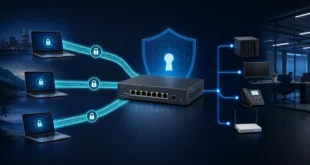
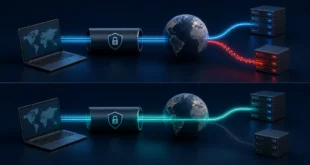
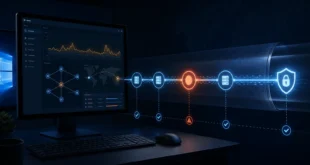
L2TP/IPsec and WireGuard can both provide remote access to a private network, but they solve the problem in very different ways. L2TP is a tunneling protocol that is normally paired with IPsec for encryption and authentication. WireGuard is a modern Layer 3 VPN protocol with a deliberately small configuration model and a fixed set of cryptographic primitives.
The practical decision is not simply “old versus new.” L2TP/IPsec can still be useful when built-in client compatibility is the overriding requirement. WireGuard is usually the better foundation for a new deployment when you control the endpoints and want a simpler, easier-to-audit design.
L2TP/IPsec and WireGuard at a Glance
| Area | L2TP/IPsec | WireGuard |
|---|---|---|
| Tunnel design | L2TP carries the tunnel; IPsec provides security | One compact VPN protocol and interface |
| Client setup | Built into Windows and supported by many existing devices | Requires a WireGuard implementation or app on the endpoint |
| Authentication | Commonly certificates or a pre-shared key, plus user authentication depending on the deployment | Public/private keys, with an optional additional pre-shared key |
| Network transport | Commonly uses IKE/IPsec and NAT traversal, which involves more moving parts | Sends encrypted packets over UDP |
| Cryptography | Depends on the IPsec proposal and client/server configuration | Uses a fixed modern suite, including Curve25519, ChaCha20-Poly1305, BLAKE2s, and HKDF |
| Addressing and access | Often integrated with traditional remote-access infrastructure | AllowedIPs combines route selection and peer access control |
| Best fit | Legacy compatibility and environments that cannot install another client | New deployments, managed endpoints, site-to-site links, and mobile users |
How the Protocols Differ
L2TP does not encrypt traffic by itself. In a normal secure deployment, IPsec protects the L2TP session. That layered design gives administrators access to mature IPsec infrastructure, certificate-based authentication, and native operating-system clients. It also introduces more configuration points: the IKE exchange, the IPsec policy, L2TP, user authentication, firewall handling, and NAT traversal all have to agree.
Windows continues to expose L2TP as a built-in VPN connection type. Microsoft documents L2TP with a pre-shared key as one of the native VPN profile options, alongside IKEv2 and other connection types. This makes L2TP/IPsec attractive when users must connect without installing a separate VPN application. See Microsoft’s current VPN connection type documentation before standardizing a Windows profile.
WireGuard presents a network interface with a private key and a set of peers. Each peer has a public key, one or more allowed IP prefixes, and—when required—an endpoint. The protocol performs a compact handshake and rotates session keys automatically. According to the official WireGuard protocol description, its construction uses the Noise framework with Curve25519, ChaCha20-Poly1305, BLAKE2s, SipHash24, and HKDF.
This fixed cryptographic design removes the negotiation matrix found in a general-purpose IPsec implementation. It reduces configuration ambiguity, but it also means WireGuard is intentionally not a complete identity-management or address-assignment system. Administrators still need a process for generating, distributing, revoking, and auditing peer keys.
Security: Configuration Matters More Than the Protocol Name
A correctly configured L2TP/IPsec deployment is not automatically insecure. Its security depends on the IPsec algorithms, authentication method, key handling, client behavior, and server policy. A weak or shared pre-shared key can undermine an otherwise sound deployment. Reusing one PSK across many unmanaged devices also makes revocation and accountability difficult.
WireGuard avoids algorithm selection and gives every peer a distinct cryptographic identity. That makes the configuration easier to review: a peer is authorized because its public key exists in the configuration and its AllowedIPs define what traffic is associated with it. The design also supports an optional pre-shared key mixed into the public-key exchange when an additional symmetric secret is required.
Neither protocol eliminates operational risk. Private keys must be protected, lost devices must be removed promptly, unused peers must be revoked, and access must be restricted to the networks and services each user actually needs. A VPN that grants every peer unrestricted access to the entire LAN is still a weak design, regardless of the tunnel protocol.
NAT, Firewalls, and Mobile Connections
L2TP/IPsec requires the firewall and NAT path to handle the IPsec negotiation and encapsulated traffic correctly. In practice, this can be more difficult across carrier NAT, restrictive guest networks, or firewalls with incomplete IPsec pass-through behavior. Troubleshooting often requires correlating IKE, IPsec, L2TP, and authentication logs rather than looking at one service.
WireGuard sends its traffic over UDP and can update a peer’s most recent authenticated endpoint. This roaming behavior is useful when a laptop or phone changes between Wi-Fi and mobile data. A peer behind NAT may need a persistent keepalive if it must remain reachable while idle. The official WireGuard quick start recommends using persistent keepalive only where NAT or firewall state requires it; it is not a setting that should be enabled indiscriminately on every peer.
For either protocol, test the real path. A tunnel that works from an office connection may fail from hotel Wi-Fi, mobile carrier NAT, or a customer network that blocks UDP. Keep an alternative administrative path available before changing a production VPN gateway.
Performance Without Misleading Benchmarks
WireGuard often has less protocol and implementation overhead than an L2TP/IPsec stack, especially on modern operating systems with efficient kernel support. That does not justify publishing a universal claim such as “WireGuard is five times faster.” Results vary with CPU architecture, encryption acceleration, router implementation, MTU, packet size, latency, NIC offload, and whether the VPN runs in kernel or user space.
Use a repeatable test instead:
- Measure baseline throughput and latency without a VPN.
- Test both protocols between the same endpoints and over the same network path.
- Record CPU utilization on the client and gateway.
- Test large transfers and many small packets.
- Repeat the test from a NATed mobile or remote connection.
- Check packet loss, retransmissions, and MTU-related failures—not only peak throughput.
The correct result is the one your actual gateway and clients can sustain, not a benchmark copied from different hardware.
When L2TP/IPsec Is the Better Choice
Choose L2TP/IPsec when all of the following are true:
- Users must connect with an operating system’s built-in VPN client.
- The existing gateway has a well-maintained, supported IPsec implementation.
- You already have a reliable certificate or credential lifecycle.
- The networks your users connect from permit the required traffic.
- Compatibility is more important than minimizing configuration complexity.
Even in this case, compare L2TP/IPsec with IKEv2 before starting a new Windows-focused deployment. Both are native options, and the best choice depends on the gateway, authentication system, and endpoint-management requirements.
When WireGuard Is the Better Choice
Choose WireGuard when you control the client devices and can install the official or platform-supported implementation. The project currently provides implementations for Windows, macOS, iOS, Android, Linux, and several BSD platforms; verify the supported package for each endpoint on the official installation page.
WireGuard is particularly well suited to:
- Site-to-site tunnels with a small, explicit peer list.
- Remote administrators using managed laptops.
- Mobile clients that change networks frequently.
- Linux servers and modern routers with supported WireGuard implementations.
- Environments where configuration review and automation are important.
Its simplicity should not be confused with automatic management. A larger deployment still needs key inventory, revocation, configuration distribution, monitoring, and a process for IP allocation.
A Safe Migration Plan
Do not replace a working remote-access service in one step. Run the protocols in parallel during a controlled migration.
- Inventory users, devices, routes, DNS requirements, and services currently reached through L2TP/IPsec.
- Create a separate WireGuard address range that does not overlap the LAN, other VPNs, or client home networks.
- Define one key pair per managed device. Do not copy a single client private key to multiple machines.
- Pilot with administrators first, using least-privilege routes in
AllowedIPs. - Validate DNS, split tunneling, internet egress, MTU, reconnect behavior, and access-control rules.
- Add monitoring for handshake age, traffic counters, gateway health, and configuration drift.
- Migrate users in small groups and keep a documented rollback path.
- Remove old L2TP accounts, certificates, firewall rules, and shared secrets only after the final group has been verified.
Frequently Asked Questions
Is WireGuard always more secure than L2TP/IPsec?
WireGuard has a smaller configuration surface and a fixed modern cryptographic design. L2TP/IPsec can still be secure when IPsec is configured with appropriate algorithms and strong authentication. Operational controls—key protection, revocation, access scope, updates, and monitoring—remain essential for both.
Does WireGuard work without installing a client?
Not on every platform. Windows, macOS, iOS, and Android have WireGuard applications or implementations, but they are separate from a traditional built-in L2TP profile. Confirm the supported client for each operating system before migration.
Should I keep L2TP/IPsec as a fallback?
Only if there is a documented compatibility need. Keeping an unused VPN service creates another authentication surface and more firewall rules to maintain. If it remains enabled, monitor it and apply the same account, certificate, logging, and patching standards as the primary VPN.
Conclusion
For a new deployment on managed devices, WireGuard is usually the cleaner choice. It reduces configuration complexity, uses a modern fixed cryptographic suite, and handles changing client endpoints well. L2TP/IPsec remains relevant when native-client compatibility is mandatory or when a supported legacy environment cannot deploy WireGuard.
Make the final decision after a controlled test on your own gateway, clients, and network paths. Protocol architecture can guide the choice, but production evidence should confirm it.