
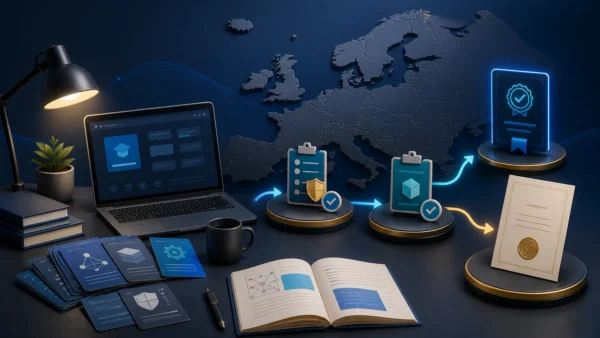
The phrase “free accredited CompTIA A+ course with an EU-recognized diploma” combines three different products: training, a vendor certification, and a nationally recognized qualification. They may appear in one funded program, but they are not interchangeable.
You can study the A+ syllabus at little or no cost. You become CompTIA A+ certified only after passing the two required CompTIA exams. A course-completion certificate does not replace those exams, and a CompTIA certificate is not automatically a state diploma mapped to a European Qualifications Framework level.
What the Official A+ Credential Requires
CompTIA’s current A+ certification page states that candidates must pass two exams: Core 1, covering hardware and networking, and Core 2, covering operating systems and security. They can be taken in either order.
The certification is issued by CompTIA after both current exams are passed. A training provider may prepare a learner for those exams, sell vouchers, or issue its own attendance certificate, but it cannot award CompTIA A+ independently.
Before enrolling, ask the provider to identify each deliverable:
| Claim | Evidence to request |
|---|---|
| “A+ course” | Syllabus mapped to the current Core 1 and Core 2 objectives |
| “Exam included” | Two valid CompTIA exam vouchers and their expiration dates |
| “CompTIA certificate” | Confirmation that certification follows passing both official exams |
| “Accredited diploma” | Accrediting authority, national register entry, qualification code, and level |
| “Recognized in the EU” | Exact recognition mechanism—not a marketing statement |
If the offer includes only a downloadable certificate bearing the course platform’s name, it is proof of course completion, not the A+ credential.
Free Training Is Not Free Certification
The lowest-cost study plan can use:
- The current official exam objectives as a checklist.
- Free videos, notes, and practice labs from reputable educators.
- A used or library textbook that matches the current exam generation.
- A small home lab or virtual machines for operating-system tasks.
- Free networking and security fundamentals modules from established vendors.
CompTIA also sells official learning products, but purchasing training is not required to sit the exams. Conversely, completing any training product does not waive the exams unless an explicit funded program pays for the vouchers.
Avoid old courses whose objectives do not match the current A+ generation. A free 2019 course may teach useful fundamentals while leaving gaps in current cloud, security, mobile, and operational objectives.
What “Recognized in the EU” Actually Means
There is no single EU office that converts every private IT certificate into a universally accredited diploma. The European Qualifications Framework is a comparison tool linked to national qualifications frameworks. It helps explain the level of formal qualifications that countries have referenced to it.
CompTIA A+ is an industry/vendor certification. Employers across Europe may value it, but employer recognition is different from formal academic or vocational recognition.
For a provider claiming an EQF or national level, verify:
- The qualification’s exact legal name.
- The awarding body.
- The national accreditation or recognition authority.
- The qualification’s entry in the relevant national register.
- The corresponding NQF/EQF level.
- Whether the program includes CompTIA exams or only covers similar content.
Europass explains that a Certificate Supplement for a vocational qualification identifies the awarding institution, achievements, and official basis. A private PDF without those details is not made “EU recognized” by adding an EU flag.
Legitimate Ways to Pay Less
Exam pricing varies by country, currency, tax, channel, and promotion. Use the country-specific CompTIA store or authorized testing flow for the current total rather than an old price quoted in a forum.
The lowest legitimate out-of-pocket route is usually one of these:
- Public employment or reskilling program: a national or regional labor agency funds training and both vouchers for eligible participants.
- School or academic program: an eligible institution offers academic pricing or includes the exams in tuition.
- Employer sponsorship: the employer pays after a training plan or reimburses a passed exam.
- Authorized training bundle: two vouchers are included at a lower total than buying a large course and exams separately.
- Self-study plus vouchers: skip paid classroom training and buy only the required exams.
Search the official Europass course catalogue and the national qualification/training portal for your country. Then verify the provider directly with the funding authority. Europass listings help discovery; they do not eliminate the need to check fees, recognition, and admission rules.
Calculate the Real Total
A low advertised course price can exclude the expensive part. Build a written cost table:
| Cost item | Included? | Conditions |
|---|---|---|
| Core 1 voucher | Yes/No | Region, expiration, retake |
| Core 2 voucher | Yes/No | Region, expiration, retake |
| Training access | Yes/No | Duration and language |
| Labs | Yes/No | Browser lab or local setup |
| Practice tests | Yes/No | Current objectives |
| Retake | Yes/No | Same exam only, deadline |
| Tax | Included/extra | Country of purchase |
| Formal diploma | Yes/No | Authority and register entry |
An inexpensive course with no vouchers may cost more in total than self-study. A funded program with attendance requirements may be financially free but expensive in time. Choose according to the outcome required by the target job.
Check a Provider Before Paying
Use this verification sequence:
- Open CompTIA’s current A+ page and note the active exam generation.
- Ask the provider for the syllabus version and two voucher terms in writing.
- Verify that the testing delivery is through CompTIA’s authorized exam process.
- Look up the provider or qualification in the national accreditation register if a state-recognized diploma is claimed.
- Ask whether the certificate names CompTIA, the training provider, or a national awarding body.
- Read refund rules for expired vouchers and failed eligibility checks.
- Pay by a traceable method and retain the invoice.
Warning signs include “lifetime A+,” one exam for full certification, a remote examiner outside the authorized platform, voucher codes sold through chat, or a provider refusing to identify the accrediting authority.
A Practical Low-Cost Plan
For a learner paying personally:
- Download the current exam objectives.
- Take a diagnostic practice test for each core.
- Study only the weak domains using current free resources.
- Build hands-on labs for Windows, Linux, networking, hardware, security, and troubleshooting.
- Re-test under timed conditions.
- Buy one regional voucher from a legitimate source when ready.
- Pass the first exam, then repeat the gap analysis for the second.
Buying the exams separately limits the amount at risk if work or study plans change. A bundle may still be cheaper when both vouchers have suitable validity and the learner is ready to finish within that period.
When a National Qualification Is the Better Goal
Choose a nationally accredited vocational program when a public-sector role, regulated pathway, immigration process, or formal education admission specifically asks for an NQF/EQF qualification. Choose A+ when entry-level IT support employers request the vendor credential or when its syllabus matches the practical foundation you need.
The two can complement each other. A funded vocational program may provide the formal qualification while including A+ exam preparation and vouchers. Verify each outcome separately in the contract.
Conclusion
Free A+ learning is widely possible; free official certification is possible only when someone else legitimately funds the two exams. A course certificate, CompTIA A+, and an EQF-referenced diploma answer different questions.
Start with the job requirement, verify the current exams, demand written voucher details, and check every accreditation claim in the national register. That approach finds the true lowest cost without paying for a “recognized diploma” that turns out to be only a completion badge.